
By Randall Douglas | Chief Consultant & CEO, Ingenuity Business Development

Spend five minutes on LinkedIn and you’ll find no shortage of opinions about artificial intelligence. Half the posts will tell you AI is going to revolutionise everything and everyone. The other half will tell you it’s mostly hype. If you’re running a business right now, you’re probably somewhere in the middle — aware that something important is happening, uncertain about what it means for you specifically, and pressed for time to figure it out.
This post is for you. Not the tech enthusiast. Not the academic. The business owner or leader who needs a clear-eyed, practical view of what AI actually is, what it can and cannot do, and — most importantly — where an organisation should start.
Let’s start with what AI is — and what it isn’t
Artificial intelligence, in the business context most relevant to most of us, is software that learns from data to make predictions, generate content, or take actions — without being explicitly programmed for every situation.
That’s it. There’s no sentience involved (at least not yet 🙂). AI doesn’t “think” the way humans do. What it does — and does extraordinarily well — is process large volumes of information, identify patterns, and produce outputs: a draft, a forecast, a recommendation, a decision flag.
The tools most businesses will encounter in 2026 fall into three broad types:
- Generative AI — tools that create text, images, code, or summaries. ChatGPT, Claude, Microsoft Copilot, and Google Gemini are the most common examples. These are already embedded in tools many of us use daily.
- Predictive AI — tools that forecast outcomes from historical data. Your bank’s fraud detection. Demand forecasting in retail. Sales pipeline scoring in a CRM.
- Process AI — tools that automate repetitive decision steps. Invoice processing, customer query triage, scheduling. Increasingly common in back-office operations.
The confusion in most organisations — and most conversations about AI — comes from merging these three. A company saying “we need to adopt AI” could mean three completely different things depending on which type they’re referring to.
Why this matters right now for T&T businesses
Trinidad and Tobago’s business environment in 2026 is under real pressure. Energy sector revenues have contracted. Foreign exchange remains constrained. The cost of doing business — labour, imported inputs, energy — has risen. Talent is harder to retain as brain drain accelerates. And consumer demand is softer than most businesses would like.
In that context, AI offers something specific and valuable: the ability to do more with the same resources. Not as a silver bullet, but as a genuine efficiency multiplier — if it’s applied correctly.
Consider what this looks like in practice for a T&T business:
- A sales team of five people can use AI drafting tools to prepare client proposals in 20 minutes instead of two hours — and spend the time saved on follow-ups.
- A marketing function can use AI to generate and test social media content across multiple platforms at a fraction of the previous cost.
- A service business can deploy an AI-assisted inbox to handle routine customer queries overnight, improving response times without additional headcount.
- A finance team can use AI-assisted Excel tools to build and update reporting models that previously required a consultant or a specialist.
None of these examples require a technology infrastructure overhaul. None require a data science team. All of them are accessible to a mid-size T&T business today, with tools that cost little or nothing to start.
An important note here as well for owners and leaders, is that more work with tight staff does not equal “fire everybody”. To the contrary, being able to do more with less, means more leads to follow, more opportunities to take advantage of – you will need more staff and to up-skill your existing staff.
The three levels of AI engagement
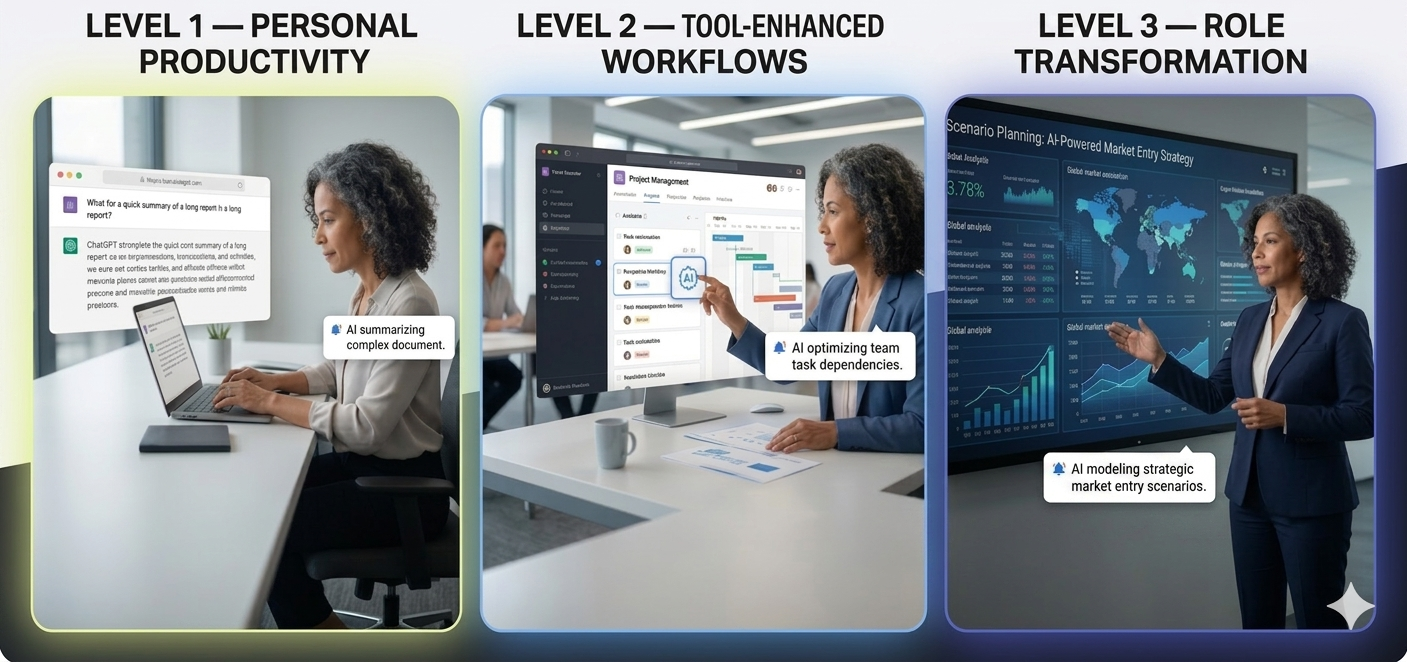
One of the most useful frameworks for thinking about AI adoption is recognising that not every organisation needs to start at the same place — or go to the same destination.
Level 1 — Personal Productivity
Individual staff members begin using AI tools in their own daily work. Drafting emails. Summarising documents. Preparing presentations. Researching topics. This is the lowest-risk, lowest-cost entry point, and it’s where IBD recommends most organisations in the Caribbean should begin. The barrier is almost zero — most tools are free or included in existing software subscriptions, such as Microsoft Office.
Level 2 — Tool-Enhanced Workflows
AI is integrated into business systems and processes. An AI-powered CRM that ranks sales leads. An accounting system that flags anomalies, variances and inconsistencies. A customer service platform that uses AI to route and respond to queries or customer support issues. This level requires deliberate decisions: which tools to use, how to configure them, what governance to put in place (this is really important). It’s where most mid-market organisations should be aiming in a 12–24 month horizon.
Level 3 — Role Transformation
AI fundamentally changes what roles exist and what they do. This is the most significant level — and the one most Caribbean organisations are at least 18–36 months from reaching. But the organisations that begin planning for it now will land it far more successfully than those who don’t.
The honest assessment for most T&T businesses today: you are at Level 1, experimenting informally, with no structure. The opportunity is to move intentionally to Level 2 with governance, a clear use-case map, and a people readiness plan.
The mistake most organisations are making
At IBD, we work with businesses across the private, public, and SME sectors. In conversations about AI over the past 18 months, we’ve seen two failure modes repeat themselves:
- Paralysis. Leaders who know AI matters but are waiting — for more certainty, for a clearer picture, for someone else to go first. The problem with this approach is that waiting has a cost: your competitors are already building competency, and the learning curve grows steeper the longer you delay.
- Reckless adoption. Organisations that purchase AI tools, automate processes, or push AI-generated content without any governance framework. This leads to data leakage, quality failures, and staff who feel threatened rather than empowered.
The path between these two failure modes is readiness — a clear-eyed assessment of where your organisation actually stands, followed by a structured, governed approach to adoption that brings your people through the change with confidence.
AI adoption, at its core, is a change management challenge, not a technology challenge. The technology decisions are secondary. The primary work is organisational, particularly process relates – are we doing the right and best thing for this particular task.
What ‘AI readiness’ actually means
At IBD, we assess AI readiness across five dimensions for every organisation we work with, who is looking at implementing AI:
- Data Readiness — Is your business data clean, structured, and accessible? AI tools are only as good as the data they work with.
- People & Literacy — Do your staff understand what AI can do? Is there openness or resistance? Literacy is the most common bottleneck.
- Process Clarity — Are your key business processes documented and measurable? AI cannot improve a process that isn’t defined. (We cannot emphasize enough how important this dimension is.)
- Technology Baseline — What systems are you currently running, and how AI-compatible are they?
- Governance & Leadership — Who owns the AI decision in your organisation? Do you have a policy for what staff can and cannot share with AI tools?
Most organisations score well on two or three of these dimensions and have significant gaps in the others. That’s not a failure — it’s a starting point. The gaps are the work.
Where CARICOM and T&T stand on AI policy
It’s worth noting that the regional and national policy environment is beginning to catch up. Trinidad and Tobago’s Ministry of Public Administration and Artificial Intelligence (MPAAI) has signalled intent to develop a national AI policy. CARICOM’s 2025 Digital Agenda and UNESCO’s Caribbean AI readiness work are creating a broader framework for how the region approaches AI governance.
For businesses, this means two things:
- The regulatory environment is still forming, so there is an opportunity to build internal governance before compliance requirements arrive.
- Organisations that demonstrate responsible AI adoption will be better positioned for government contracts, export markets, and investor scrutiny as standards emerge.
Where to start … today
If you’re reading this as a business owner or senior manager and wondering what the practical first step looks like, here’s IBD’s honest recommendation:
- Have an honest conversation with your leadership team about where you actually stand. Not where you’d like to be — where you are. Use the five readiness dimensions above as your framework.
- Pick one function and one use case. Don’t try to transform the whole business. Find the place where AI can save your team the most time with the least risk — and start there.
- Put basic governance in place before you expand. Decide what data staff can share with AI tools, who owns the AI decision, and how you’ll evaluate quality. A one-page policy is enough to start.
- Bring someone alongside you. AI adoption without structured guidance tends to drift. External support can go a long way. IBD’s AI for Business practice is built specifically to help Caribbean organisations navigate this journey — from readiness assessment through to adoption and governance.
IBD AI for Business IBD’s AI for Business practice offers three entry points: a complimentary 45-minute AI Readiness Diagnostic, a full-day AI Literacy Workshop for leadership and management teams, and structured AI Governance & Adoption Advisory for organisations ready to move from awareness to implementation. All programmes are built for the Caribbean business context — not a global template. Book your free AI Readiness Diagnostic: calendly.com/ibdtt/free-consultation-meeting | WhatsApp: +1 868 280 8288
Randall Douglas is the Chief Consultant and CEO of Ingenuity Business Development (IBD), a management consulting firm based in Port of Spain, Trinidad and Tobago. IBD serves SME, corporate, and public sector clients across the Caribbean in strategic planning, sales and marketing transformation, professional development, and AI for Business.