
By Randall Douglas | Chief Consultant & CEO, Ingenuity Business Development

Four days. Twenty Nine business owners. Cloud tools, AI analytics, cybersecurity protocols, and ecommerce frameworks delivered rapid-fire by Caribbean Export Development Agency in Port of Spain.
I attended Caribbean Export’s Digital Transformation Bootcamp in Trinidad expecting the familiar pitch: modernise your systems, adopt new technology, move to the cloud. What I got instead was something more honest, more specific, and far more useful for Caribbean businesses trying to navigate digital transformation in 2026.
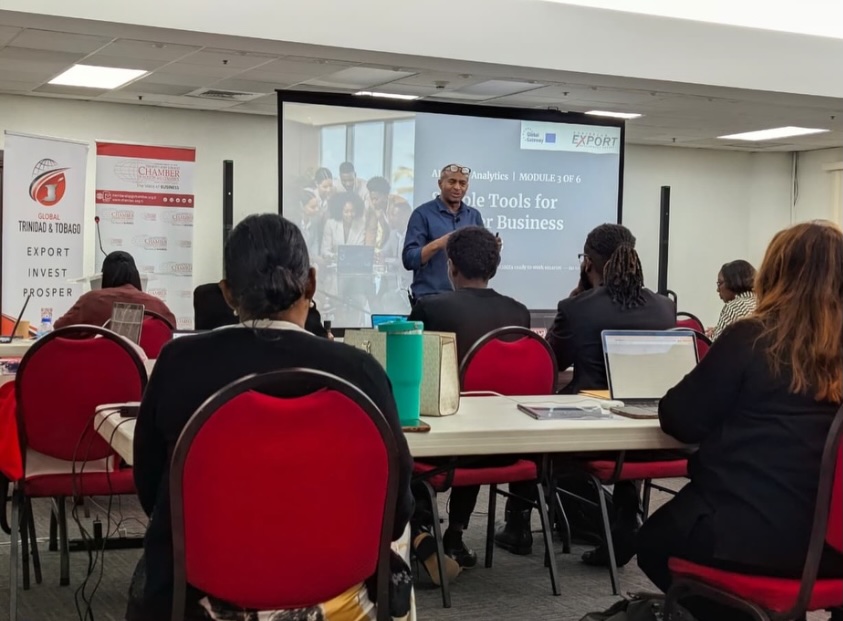
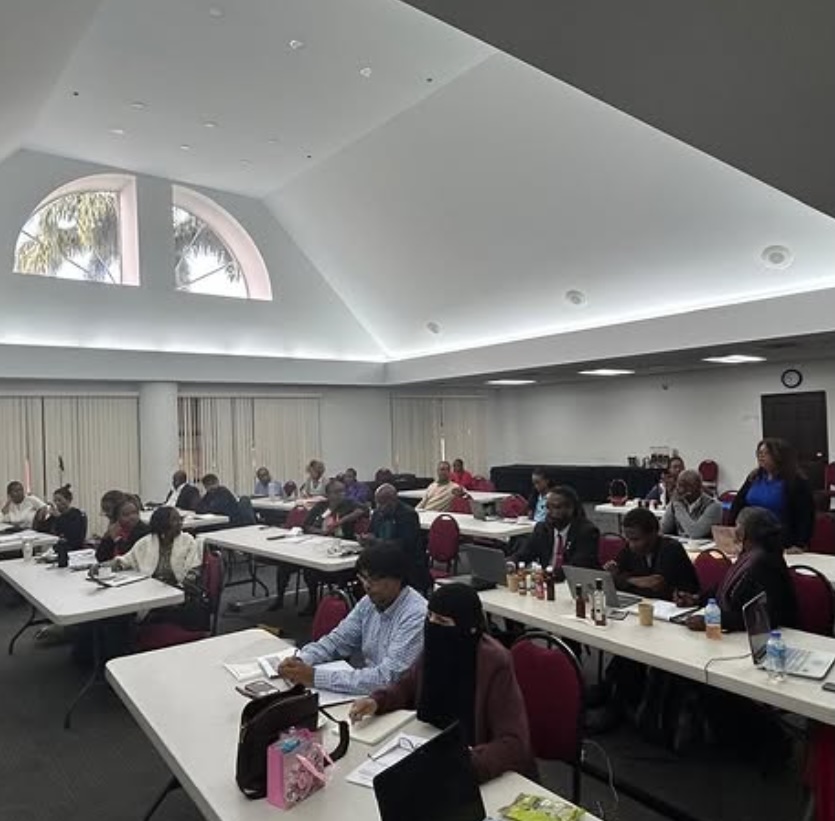
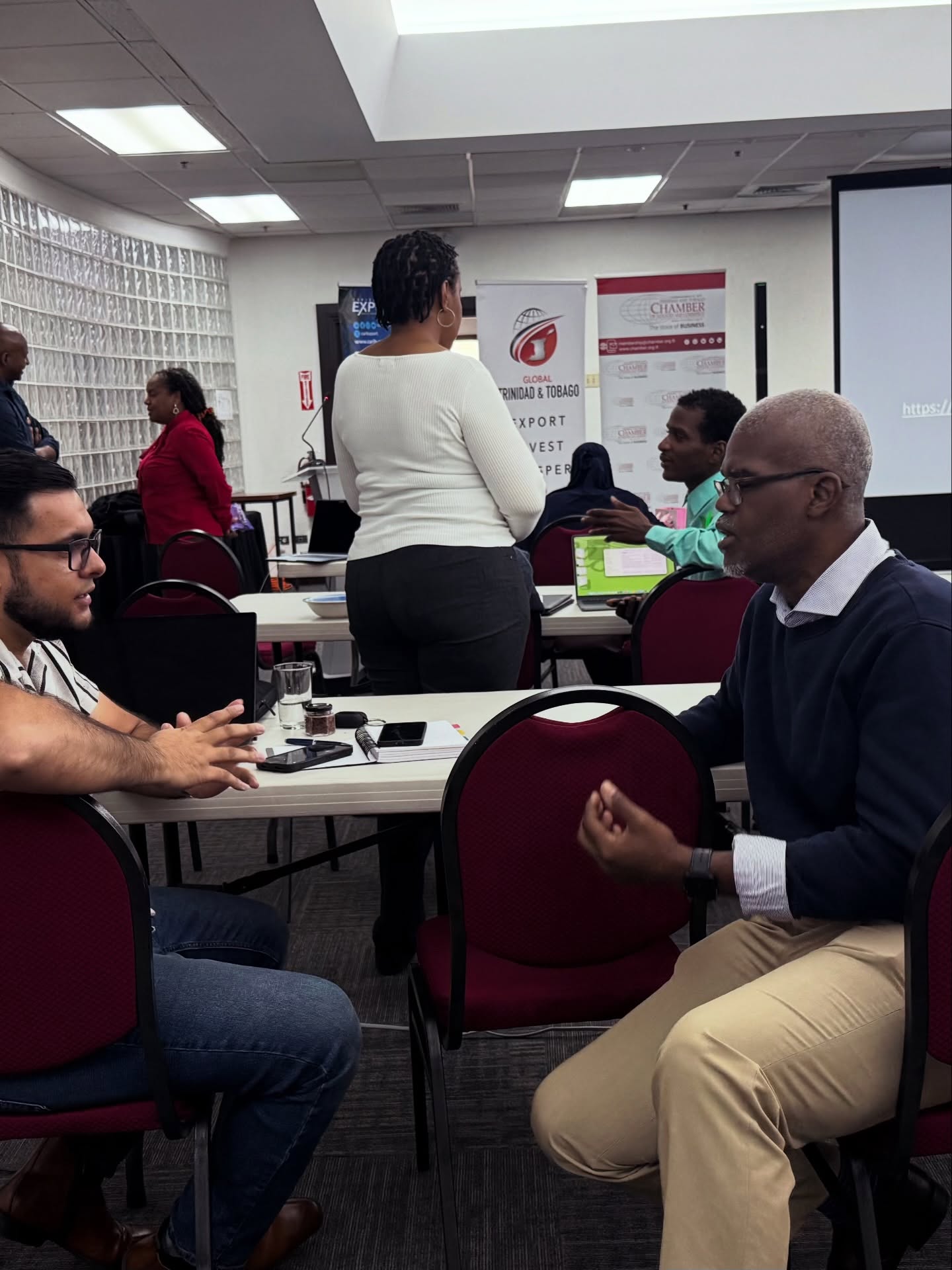
Photos courtesy of GlobaTT
Special “shoutout” to GlobaTT, Caribbean Export Development Agency, Trinidad and Tobago Chamber of Industry nd Commerce and the Euroiean Union for facilitating this workshop and making it available to SME’s.
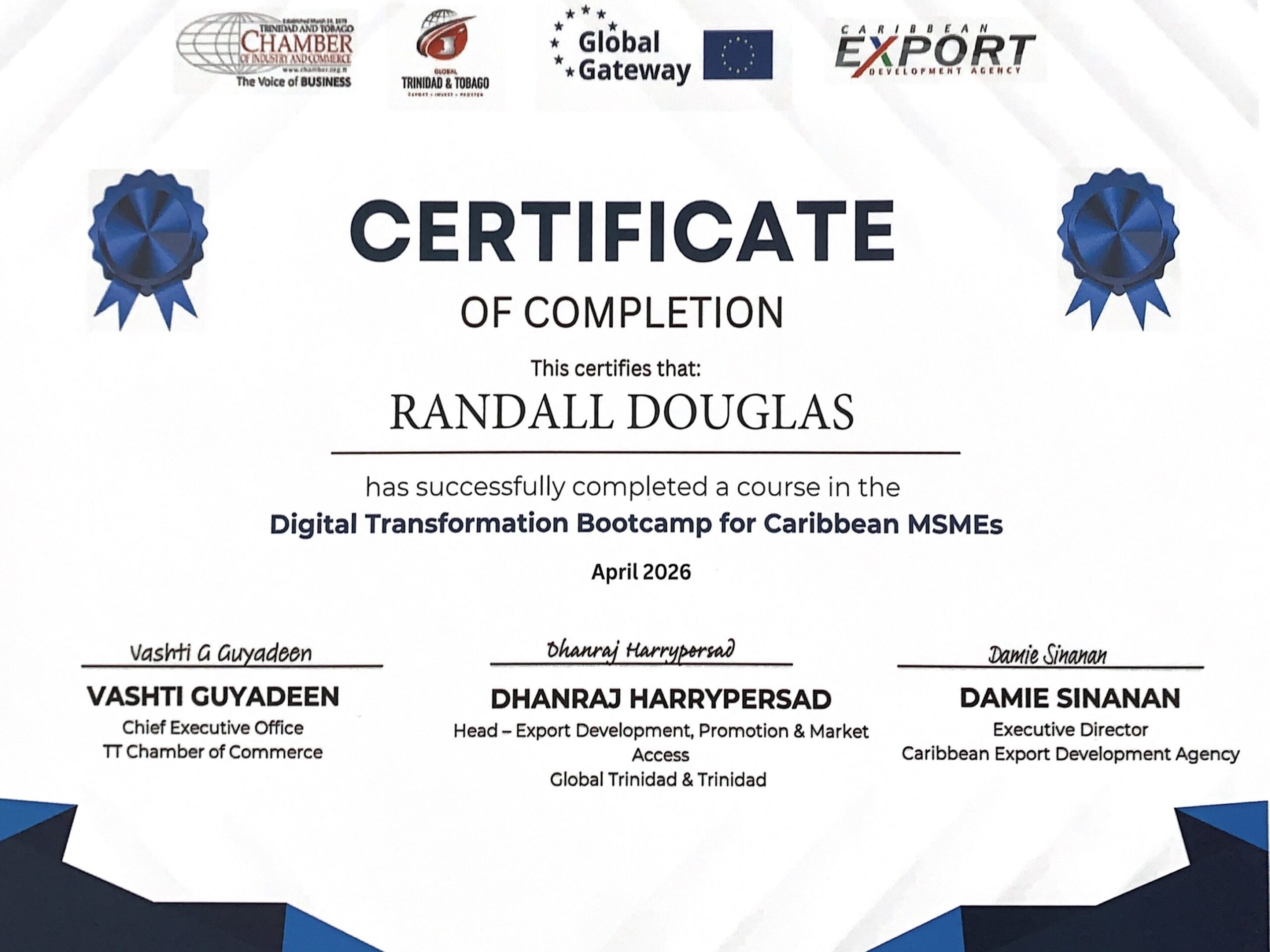
The central message, delivered across four intensive days, was this: digital transformation is not about technology. It’s about fixing your processes first, understanding the business problem you’re solving, and only then applying technology to amplify what already works.
Fix the engine before you add the turbo

One of the sharpest insights came early from Day One: automation accelerates whatever process you feed it. If your process is broken, automation makes it break faster at scale.
A manufacturing business with unclear approval chains won’t benefit from workflow automation—it will just create automated chaos. An ecommerce site with a delivery framework that doesn’t account for T&T’s logistics reality won’t scale by adding payment gateways. It will fail faster.
This matters in the Caribbean context because most SMEs are operating with informal, undocumented processes that evolved organically rather than being deliberately designed. The business owner knows how things work. Two or three key staff members know how things work. But that knowledge isn’t documented. It isn’t standardised. And the moment you try to automate it, the gaps become immediately visible.
The bootcamp’s advice: map your current process end-to-end before touching any technology. Identify bottlenecks, redundancies, and decision points. Fix what’s broken. Simplify what’s unnecessarily complex. Only then, consider which technology tools might support the improved process.
The 50-30-20 framework for transformation budgets
When a Caribbean business allocates budget for digital transformation, the natural instinct is to spend heavily on technology: software subscriptions, cloud infrastructure, hardware upgrades.
The bootcamp recommended a different split: 50% on technology, 30% on change management and training, and 20% on process redesign and consulting.
That 30% allocation for change management isn’t optional. It’s the difference between a successful transformation and an expensive software shelf.
Technology adoption fails when staff don’t understand the rationale, haven’t been trained properly, and see the new system as something imposed on them rather than something designed to make their work easier. The 30% buys time: time for structured onboarding, time for skills development, time for feedback loops that allow the organisation to adjust the implementation as problems surface.
For T&T businesses, this is particularly relevant given the shortage of digital-native talent and the brain drain pulling experienced people out of the region. You cannot assume staff will adapt automatically. You need to build capability deliberately.
Start with business problems, not technology solutions
One of the recurring themes across the bootcamp: most digital transformation projects fail because they begin with a technology decision rather than a business problem. (I thought this was a 🔥 statement!).
“We need AI.” What problem are you solving with it?
“We need to move to the cloud.” Why? What outcome are you aiming for?
“We need an ecommerce platform.” Are your customers asking for it? Do you have a delivery framework that works?
The advice: name the business problem first. Revenue is stagnant and customer acquisition costs are too high. Cash flow visibility is poor and forecasting is manual. Customer service response times are creating churn. Inventory management is creating out of stock moments.
Once the problem is clear, you can evaluate whether a technology solution is the right intervention—and if so, which one. But starting with technology and working backwards to find a problem it might solve is how organisations end up with underused CRMs, abandoned dashboards, and expensive software that solved a problem nobody had.
AI and data: know your numbers, build your starter plan

Day two tackled AI and data analytics, and the message was pragmatic: start small, focus on quick wins, and don’t wait for perfect data.
One of the clearest pieces of guidance: develop an AI starter plan. This doesn’t mean hiring data scientists or overhauling your IT infrastructure. It means identifying three to five use cases where AI tools—most of which are free or low-cost—can produce measurable improvements in the next 90 days.
Examples from the bootcamp:
- Use AI-powered summarisation tools to process customer feedback at scale and identify recurring themes.
- Deploy AI writing assistants to draft client proposals, social media content, and internal reports faster.
- Use predictive analytics to forecast inventory demand based on historical sales data and reduce out of stock situations.
- Apply AI-assisted Excel tools to automate financial reporting and flag anomalies for review.
The emphasis was on accessibility. Most of these tools require no specialised skills and can be tested with minimal investment. The risk is low. The learning curve is manageable. And the potential time savings—particularly for small teams stretched across multiple roles—are significant.
But there was also a critical warning: AI tries to please you. If you’re using AI to analyse data, generate forecasts, or produce recommendations, you need to bring domain expertise and critical judgment. AI is a tool that amplifies capability. It does not replace it.
Ecommerce for Caribbean businesses: sell the experience, not just the product

Day three covered ecommerce, and the guidance here was specific and immediately relevant for T&T businesses considering online sales.
The benefits are real: 24/7 access, a global customer base that is already accustomed to buying online, resilience to physical shocks like lockdowns or flooding, and the creation of a transferable digital asset with long-term value.
But the warning was equally clear: ecommerce in the Caribbean requires solving constraints that developed markets don’t face. Payment gateway access for T&T merchants is limited. Delivery logistics are inconsistent. Legal frameworks for consumer protection in online transactions are underdeveloped. And the forex environment makes international pricing and payment collection complex.
The bootcamp’s advice: solve the constraint before launching the platform. If delivery is unreliable, partner with a courier service and build that cost into your pricing model. If payment gateways are limited, consider regional banking solutions like JMMB Jamaica’s commercial banking services that support Caribbean ecommerce.
And price for reality, not for competition. The bootcamp emphasized: “We are not in a race to the bottom.” Caribbean businesses cannot compete on cost with global ecommerce giants. The differentiation is in the experience: the story, the curation, the customer relationship, the brand positioning as mid-to-high value.
One principle stood out: always be selling the experience, not just the product. What is the story you’re telling? What does buying from you signal about the customer? How does the unboxing feel? Ecommerce platforms are technology, but ecommerce success is about brand experience translated digitally.
Cybersecurity: protect the basics before chasing sophistication

Day four covered cybersecurity and ransomware readiness, and the guidance here was refreshingly direct: most Caribbean SMEs don’t need enterprise-level security infrastructure. They need to execute the basics correctly.
The bootcamp outlined a practical baseline:
- Enable two-factor authentication on all business accounts.
- Implement the 3-2-1 backup rule: three copies of your data, on two different media, with one off-site.
- Keep systems updated—security patches exist for a reason.
- Use biometric authentication where possible.
- Secure WiFi networks and consider segmented networks for sensitive data.
None of this is glamorous. None of it is expensive. But the failure to implement basic protocols is what leaves businesses exposed—not the absence of sophisticated intrusion detection systems.
For T&T businesses, ransomware is a real and growing threat. The bootcamp made clear: insurance won’t save you if your data is encrypted and your backups are compromised. Prevention is the only reliable strategy. Execute the basics. Audit your vulnerabilities. And build a recovery plan before you need one.
What Caribbean businesses actually need: clarity, process, and execution discipline

The bootcamp’s real value wasn’t in introducing new technology. Most participants already knew about cloud tools, AI platforms, and ecommerce systems. What they got instead was permission to slow down, fix the fundamentals, and approach digital transformation as a business discipline rather than a technology exercise.
Three principles carried through every session:
- Define your core competence and delegate everything else. Know what you do well, protect it, and outsource or automate the rest.
- Develop a personal operating system. Build repeatable routines, decision frameworks, and productivity habits that free up mental bandwidth for strategic thinking.
- Know your numbers. You cannot optimise what you don’t measure. Track the metrics that actually matter to your business model and review them weekly.
For Caribbean businesses in 2026, the constraints are real: foreign exchange pressures, talent shortages, higher input costs, and softer consumer demand. Digital transformation won’t solve all of those problems. But applied correctly—starting with business objectives, fixing processes first, and building capability alongside technology—it offers a genuine efficiency multiplier.
The organisations that get this right won’t be the ones with the most sophisticated “tech stack”. They’ll be the ones that identified the right problems, built the right processes, and deployed the right tools to amplify what was already working.
Where IBD can help
IBD works with Caribbean organisations to build the strategic clarity and operational discipline that make digital transformation work. Whether you’re evaluating AI readiness, redesigning operational processes, or building change management capability to support technology adoption, we bring structure, global best practice, and a clear-eyed assessment of what actually works in the Caribbean business environment.
Our fourth practice area—AI for Business—is specifically designed for organisations that want a pragmatic entry point into AI adoption. We offer readiness assessments, facilitated workshops, and implementation support that moves from strategy to execution without assuming technical infrastructure or specialist staff.
Our Change Management practice supports organisations through transformation projects—digital or otherwise—with leadership alignment, staff engagement, and the accountability structures that turn plans into outcomes.
And our Strategic Planning work helps leadership teams move from high-level ambitions to executable operational plans with clear KPIs, resource allocation, and quarterly review cadences.
Every engagement begins with a complimentary consultation to understand your specific context, challenges, and objectives.
| IBD Strategic Planning | Change Management | AI for Business IBD facilitates strategic planning, change management, and AI readiness programmes for Caribbean businesses across private, public, and SME sectors. Every engagement begins with a complimentary consultation to understand your specific planning context and challenges. Book a free consultation: calendly.com/ibdtt/free-consultation-meeting WhatsApp: +1 868 280 8288 |
Randall Douglas is the Chief Consultant and CEO of Ingenuity Business Development (IBD), a management consulting firm based in Trinidad and Tobago. IBD has facilitated strategic planning, change management, and sales and marketing transformation programmes for organisations across the Caribbean since 2008.