
By Randall Douglas | Chief Consultant & CEO, Ingenuity Business Development

Every year, thousands of Caribbean businesses produce strategic plans. They commission consultants. They hold leadership retreats. They develop vision statements, SWOT analyses, PESTLE frameworks, priority pillars, and cascading KPIs. The documents are often excellent — well-researched, clearly written, professionally presented.
And then almost nothing happens.
Twelve months later, the plan is gathering dust in a folder on the server, or printed and filed in a cabinet, or still open on someone’s laptop as a reference that nobody references. The business has continued doing what it was doing before the retreat, adjusted slightly by immediate pressures and whoever happened to be loudest in the room on any given week.
This is not a T&T problem or a Caribbean problem. It is a universal problem with business planning. But it has specific characteristics in this market that are worth naming directly — because you can’t fix a problem you haven’t diagnosed accurately.
The retreat is not the strategy
The most common misunderstanding about strategic planning is that the retreat is the main event. The thinking, the alignment, the document — these feel like the work because they are the visible, structured part. But the retreat is actually just the beginning of the work. It is the place where direction is set. Execution is everything that comes after.
In my experience facilitating strategic planning processes across the private, public, and SME sectors in T&T, the ratio tends to be something like this: organisations spend 80% of their strategic planning energy on producing the plan and 20% on implementing it. The ratio should be reversed. The plan is relatively easy to write. Execution is hard, sustained, and uncomfortable.
The five reasons Caribbean business plans fail
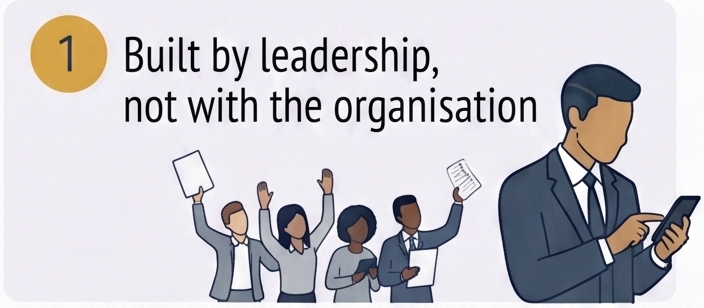
1. The plan was built by leadership, not with the organisation
Strategic plans that are developed in isolation at the top and then handed down for execution, almost always fail to generate the buy-in required for sustained implementation. The people being asked to execute the strategy were not involved in creating it. They don’t understand the reasoning behind it. They have their own views about what the priorities should be. And when the plan conflicts with the day-to-day reality they live in, the day-to-day reality wins.
This is particularly acute in T&T organisations, where hierarchical structures are common and “consultation” is often performative rather than genuine. Leaders share the plan, not the thinking. And the organisation nods politely, smiles and waves and carries on.
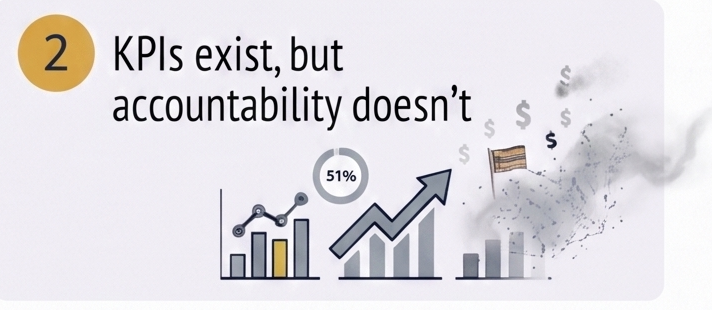
2. KPIs exist but accountability doesn’t
Most strategic plans contain metrics: revenue targets, customer satisfaction scores, staff development hours, new product launches. But metrics without accountability structures are wishes, not measures, dreams and not goals. Who is responsible for each KPI? How often is it reviewed? What happens when it’s missed? Who has the authority to reallocate resources when a strategic priority is falling behind?
In the organisations we work with, the most common answer to these questions is vague. Responsibility is shared, which means it is owned by nobody. Reviews happen quarterly at best, which means problems fester for months before they’re visible. And consequences for missing targets are unclear, which means there is no real incentive structure supporting the strategy.
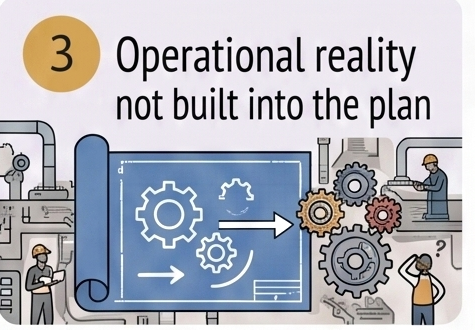
3. Operational reality was not built into the plan
A strategic plan that ignores the capacity of the organisation to execute it is not a strategy. It’s a wish list. We have seen organisations in T&T produce ambitious five-year plans while simultaneously managing a high job vacancy rate, a forex-constrained import budget, and a technology infrastructure that hasn’t been updated in a decade.
The plan looked excellent. The organisation had no realistic path to implementing it. And rather than confronting that gap, leadership deferred — assuming conditions would improve, or that the ambition itself would somehow create the capacity. It doesn’t work that way.
4. The environment moved and the plan didn’t
A strategic plan written in January 2025 for a T&T business was operating on assumptions about energy revenues, forex availability, inflation, and consumer demand that were already outdated by mid-year. The world moves. Markets shift. Competitors act. Staff leave. Government policy changes.
Plans that are treated as fixed documents rather than living frameworks become obsolete faster than they’re implemented. Organisations need a review cadence, a rhythm — typically quarterly — that allows the strategy to be adjusted based on what’s actually happening in the market, without abandoning the underlying direction.
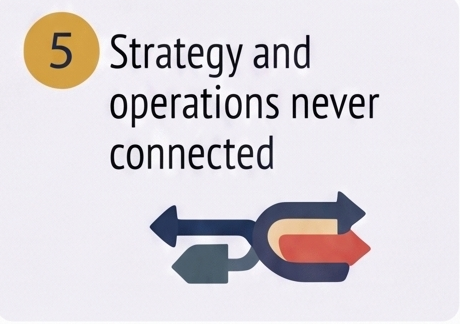
5. Strategy and operations were never connected
Perhaps the most common structural failure we observe: the strategic plan lives at the leadership level and never successfully translates into what each department, team, and individual actually does differently on Monday morning. There is no operational plan that breaks the strategic priorities into departmental action plans. There is no mechanism that connects the annual budget to the strategic priorities. There is no conversation between the strategy and the daily decisions people make.
The strategy becomes a document about the organisation’s aspirations. Operations continue to be managed by whatever is most urgent today. These two things coexist in parallel, never quite meeting.
What a strategy that actually executes looks like – the promised land!

IBD has facilitated strategic planning processes for organisations including Queen’s Hall, Agricultural Development Bank, and multiple private sector companies across T&T. The ones that execute well share a set of common characteristics that are worth spelling out:
The leadership team is genuinely aligned
Not publicly aligned — genuinely aligned. There is a difference. Genuine alignment means that the CEO, the CFO, the heads of sales, operations, HR, and every other function have had the difficult conversations about priorities, trade-offs, and resource allocation — and reached actual agreement. Not compromise. Not “I’ll support this publicly but undermine it privately.” Real alignment.
Building this alignment is the hardest and most important part of the strategic planning process. It cannot be rushed, and it cannot be faked. A strategic plan built on surface alignment will fail the moment the first difficult decision is required.
Accountability is structural, not aspirational
The operational plan that follows from the strategy assigns specific responsibility for each priority to a named individual. That individual has a quarterly review with leadership at which their progress is assessed against measurable milestones. There are consequences — positive and negative — for performance. The accountability system is built into the management rhythm of the organisation, not bolted on top of it.
The budget follows the strategy
One of the most reliable indicators that a strategic plan is not serious is when the annual budget was built before the strategic priorities were finalised, or when strategic priorities exist that have no budget allocation. If the strategy says “customer experience is a top priority” but the budget for customer service training and systems has been cut, the strategy is not the strategy. The budget is.
There is a quarterly review cadence
The strategy is reviewed every quarter by the leadership team. Not to produce a report — to make decisions. What is ahead of plan? What is behind? What has changed in the environment? What adjustments need to be made? The quarterly review is where the strategy stays alive and responsive. Without it, the plan becomes historical rather than directional.
Execution is treated as a discipline, not an assumption
Execution doesn’t happen because smart people know what to do. It happens because there are systems, structures, rhythms, and accountabilities that make it the path of least resistance. Organisations that execute well have built those systems deliberately. They haven’t assumed that good intentions and a clear plan are enough. They are not.
A practical starting point for the rest of 2026
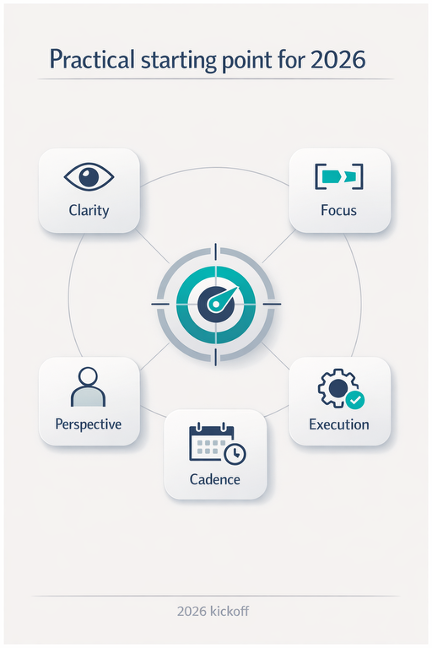
It’s never to late to start, business plans are supposed to be dynamic and reviewed over short periods. So if your organisation has a strategic plan business plan that the organisation itself or even the plan structure is not executing — OR if you’re approaching the planning process for the balance of the year or a different accounting calendar year — here is my honest advice for where to start:
- Clarity – Audit the current plan honestly. Before producing anything new, assess what happened with the last one. Which priorities were pursued? Which were abandoned? Where did execution break down? The answers will tell you more about your organisation’s execution capability than any new planning exercise will.
- Focus – Reduce the scope to what you can actually execute. Most strategic plans contain too many priorities. Three to five well-executed priorities create more value than fifteen half-started ones. Be ruthless about what makes the list.
- Execution – Build the operational plan before the retreat is over. Don’t leave the strategic priorities as high-level statements. Before the room breaks up, assign accountability, define milestones, and identify the resource implications. If you can’t do that in the room, the priority isn’t ready.
- Cadence or Rhythm – Lock in the review cadence on the day. Agree the date of the first quarterly review before anyone leaves the retreat. Put it in calendars. Treat it as a non-negotiable leadership obligation, not an optional scheduling exercise.
- Perspective – Bring someone objective into the room. That may sound like a pitch for IBD … well it is that too, BUT one of the most valuable things an external facilitator does is hold the leadership team to account for the difficult conversations that internal dynamics tend to avoid. The consultant’s role is not to produce the plan — it is to ensure that the process surfaces the real issues rather than papering over them. Don’t drink your own Kool-Aide.
Above all, don’t let the goal blind you from the journey. You have to put in work before you can realize benefits and generate a great business plan.
Remember a kite rises against the wind, not with it, don’t be afraid of criticism and uncomfortable truths. Embrace them as challenges.
IBD Strategic Planning IBD facilitates strategic planning processes for Caribbean businesses across the private, public, and SME sectors — from initial vision and alignment work through to operational planning, KPI design, and quarterly review support. Every engagement begins with a complimentary consultation to understand your specific planning context and challenges. Book a free consultation: calendly.com/ibdtt/free-consultation-meeting | WhatsApp: +1 868 280 8288
Randall Douglas is the Chief Consultant and CEO of Ingenuity Business Development (IBD), a management consulting firm based in Trinidad and Tobago. IBD has facilitated strategic planning, change management, and sales and marketing transformation programmes for organisations across the Caribbean since 2008.